
Jonesport History
A history forged by the sea and its people.
How the seafaring trades shaped the town's history
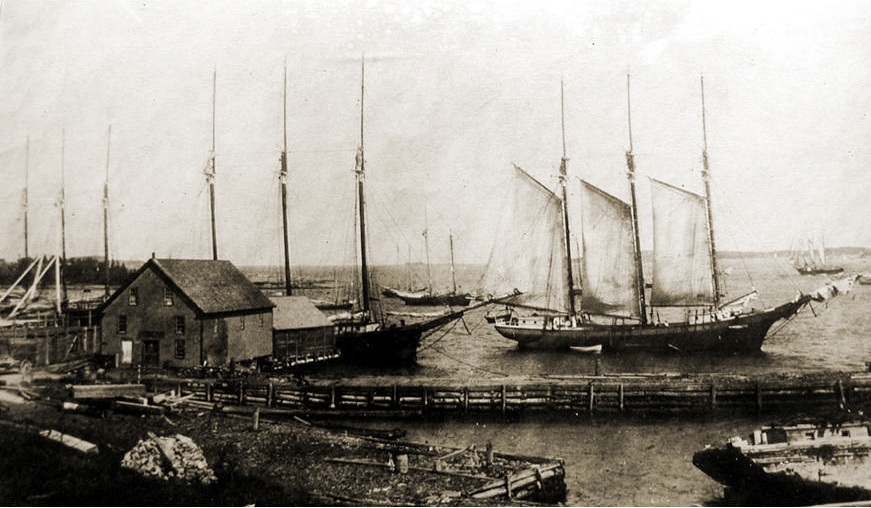
The site where the existing marina and proposed expansion are located was in commercial use from Jonesport’s earliest days. Old photos show that the area where the marina is now was built out and bulkheaded.
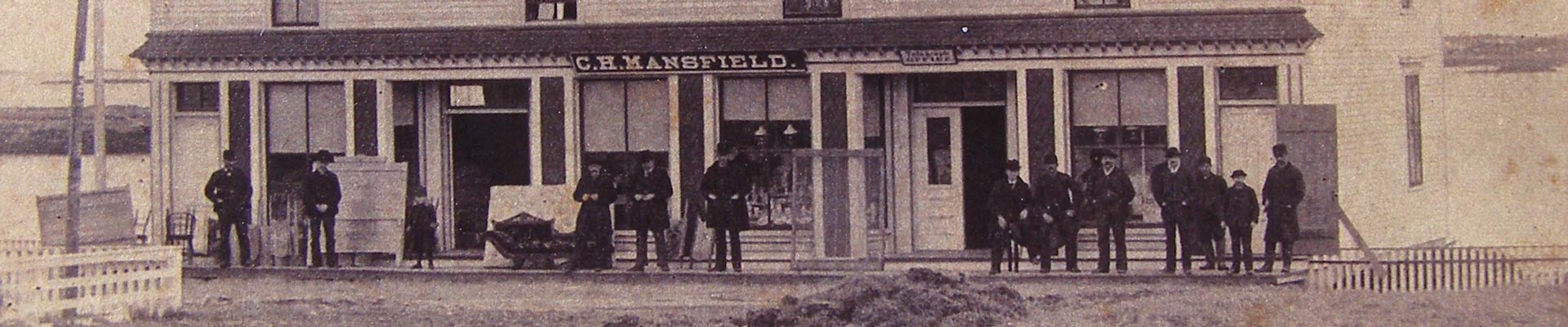
In 1853 the first steamboat, Rockland, began service up and down the Maine coast. As this form of travel and shipping became more prevalent, Jonesport began to establish itself as a trading center for fishermen and the outlying islands. Sea captains built their homes here, finding it a good port on the Downeast route from Boston to Canada. Ships from Jonesport sailed worldwide, and many of today’s families count among their forebears captains or crew members who lost their lives on the high seas. The town provided not only the seamen for the ocean voyages but also the goods needed. Early mercantile stores on the harbor front were operated by D.J. & E.M. Sawyer and B.B. Mansfield.
The Mansfield Store, originally built about 1880, housed the telegraph office, a general store, and a ship’s chandlery. Most recently, it was a B&B known as the Harbor House.
Initially known for a cod and herring fishery that sold its smoked, dried, or heavily salted catch throughout the eastern U.S., Jonesport developed a valuable new resource in live lobsters, transported down the coast in smacks with wet wells. For nearly a hundred years, starting around 1875, demand for cheap, nonperishable protein also kept herring fishermen actively seining, and their wives packing fish in three bustling sardine canneries on the waterfront. Today Jonesport is one of New England’s busiest lobstering ports, while also serving national and international markets for scallops, mussels, clams, quahogs, sea urchins, crabs, bloodworms, periwinkles, and sea cucumbers. Our town even gave its name to the pickup truck of the sea—the renowned sea-kindly “Jonesporter” style lobster boat.
Jonesporters have always fiercely defended their independent way of life. For example, in March 1814 a British privateer, Vim, chased an American revenue cutter commanded by Capt. Elliott of Machias into Jonesport. The privateer fired several shots at the revenue cutter, and Capt. Elliott had to run his ship aground in Sawyer’s Cove to keep his men from being captured. The British had launched a barge to take the cutter as a prize when citizens on the shore opened fire with their flintlock muskets. The British sailors in the barge had no choice but to surrender. A deal was struck with the British captain, who agreed to leave if his men were returned. Frames of the revenue cutter can still be seen in the mud at low tide, at the head of Sawyer’s Cove.
Jonesport Facts
- There is no other town named Jonesport in the entire U.S.
- The town of Jonesport has more than 110 miles of coastline and is home to approximately 264 commercial fishermen. Over half of employed Jonesport residents work in the town or its local waters. There are over 1,200 acres in Jonesport owned for public access or conservation purposes.
- According to the 2000 U.S. Census, the primary occupation of 24.7% of Jonesport’s population is “agriculture, forestry, fisheries [or] mining,” compared to 10.9% of Washington County as a whole.
- Depending on the season, Jonesport’s fishermen harvest lobsters, scallops, mussels, clams, quahogs, sea urchins, crabs, bloodworms, periwinkles, sea cucumbers, and rockweed.
- Jonesport’s state-owned marina on Sawyer’s Cove, built and maintained for recreational use, offers space for commercial fishermen to park their cars, trucks, and boat trailers, launch and haul boats, and load or unload gear or the day’s catch on floats.
- Although Jonesport was settled before the American Revolution, eastern Massachusetts didn’t become the State of Maine until 1820. Twelve years later, the “Port of Jonesboro” became Jonesport.
- In the War of Independence, a sloop belonging to John C. Jones was lost when the British besieged Castine (Maine). As compensation, the Massachusetts state legislature granted him a large tract of land that included what later became Jonesboro and Jonesport.
Town Statistics & Data
Census Information (2010)
Population: 1370
Median age: (years) 49.0
Households: 599
Jonesport’s population increased in the early part of the 20th century with a peak of 2,129 residents in 1910 and a steady population decline until 1940, when Jonesport’s population rebounded from 1,641 residents in 1930 to 1,745 individuals. After the 1950s, the population declined steadily to its current population of 1317 individuals.
Census data for the 21st century reveals that Jonesport’s population has declined by an average of 45 residents per decade. However, the Maine Office of Policy and Management forecasts a population increase to 1,402, representing a 5.3% increase between 2018 and 2038.
Jonesport Historical Society Museum & Heritage Center
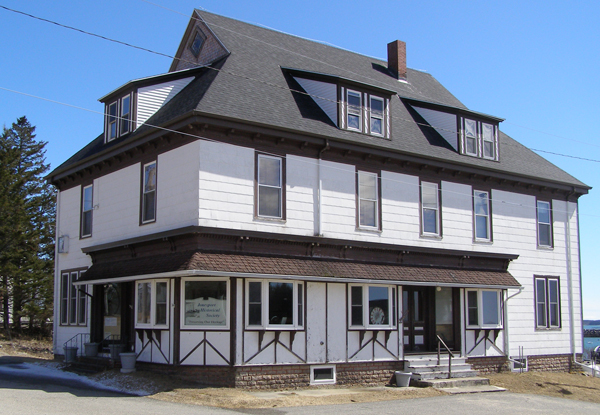
Whether you’ve lived in Jonesport your whole life, recently made it home, or are discovering it for the first time, the Jonesport Historical Society (JHS) welcomes you to explore the town’s past and the families who’ve shaped it over generations.
Many current residents can trace their families back to the town’s early days, even before Jonesport was incorporated as a town by Act of the Legislature on February 3, 1832. The JHS has documented and preserved much of the rich heritage of Jonesport, and provides "digital tours" of its history.
Inside the JHS Museum, you’ll find a broad collection of artifacts from the days when the Sawyer Building served the community as a general store, a ship’s chandlery, a bank, and a customs office. The Jonesport Heritage Center also provides access to three searchable computer databases: Genealogy, Cemeteries, and Archives.
The Heritage Center & Museum is open to the public in July and August on Tuesdays and Saturdays, and may also be visited by request from May through October. Please refer to their online calendar for exact dates and hours.
Visit the Jonesport Historical Society website to learn more about the town’s history and browse a curated collection of historic photographs.
Moosabec History
References:
Moosabec Reach East Inlet (at Marinas.com)
Ref: Chapter A, Community Vision and Executive Summary (Town of Jonesport Comprehensive Plan)
Town of Jonesport Community Facts
Community Facts (Town of Jonesport website)
View a slideshow of historical Jonesport images at the Town of Jonesport website.
Select a photo to view it larger and browse the gallery.